If you are preparing for the European Diploma in Intensive Care (EDIC), you have probably already realised that this is not just another postgraduate medical examination. Most candidates start their preparation assuming that years of experience in the intensive care unit will be enough. Unfortunately, many discover that the EDIC requires a very specific style of knowledge, exam technique, and preparation strategy.
The challenge is not necessarily that the questions are impossible. The challenge is that the syllabus is vast. Intensive care medicine sits at the intersection of physiology, anaesthesia, emergency medicine, respiratory medicine, cardiology, nephrology, infectious diseases, neurology, ethics, statistics, and much more. Few clinicians work in an environment where they encounter every aspect of the syllabus regularly.
As a result, many excellent intensivists find themselves revisiting subjects they have not studied in detail since medical school. Basic physiology, respiratory mechanics, acid-base chemistry, pharmacokinetics, statistics, and endocrine physiology frequently appear in the examination and can catch experienced clinicians off guard.
The good news is that thousands of doctors have successfully passed the EDIC examination, and there are clear patterns among those who perform well.
The purpose of this article is to provide a realistic roadmap for candidates preparing for EDIC Part 1, based on common experiences shared by successful candidates across Europe and beyond.
Understanding What the EDIC Exam Actually Tests
One of the biggest mistakes candidates make is assuming that the examination primarily assesses day-to-day clinical decision-making.
Clinical experience is certainly important, but the EDIC examination is fundamentally a knowledge-based assessment. The examiners expect candidates to understand why things happen, not simply what to do.
For example, many ICU clinicians can recognise acute respiratory distress syndrome and manage a ventilated patient appropriately. However, the EDIC examination may ask detailed questions about respiratory physiology, pressure-volume loops, oxygen transport, ventilation-perfusion mismatch, or pulmonary vascular resistance.
Similarly, most intensivists routinely prescribe vasopressors, but the examination may focus on receptor pharmacology, intracellular signalling pathways, or haemodynamic physiology.
This distinction is important because it influences how you should revise. Reading only clinical guidelines will rarely be sufficient. Understanding the underlying science behind critical care is often the key to answering difficult questions correctly.
Why So Many Candidates Struggle with EDIC Part 1
The most common reason candidates fail is not lack of intelligence or lack of clinical experience. It is usually a mismatch between preparation and examination style.
Many candidates spend months reading textbooks but complete very few practice questions. Others focus heavily on one favourite area such as mechanical ventilation while neglecting statistics, ethics, or endocrinology.
Another common problem is passive learning.
Reading chapters repeatedly can create the illusion of progress. The information feels familiar, but familiarity is not the same as recall. The examination requires rapid retrieval of information under pressure.
Candidates who perform well usually spend a significant proportion of their preparation time answering questions, identifying weaknesses, and repeatedly testing themselves.
The reality is that active recall consistently outperforms passive reading.
The Most Important Subjects in EDIC Preparation
Although every topic in the syllabus is potentially examinable, certain themes appear repeatedly.
Respiratory physiology remains one of the foundations of intensive care medicine and frequently contributes a substantial proportion of questions. Candidates should feel comfortable with gas exchange, oxygen transport, respiratory mechanics, ventilation-perfusion relationships, dead space physiology, and mechanical ventilation principles.
Cardiovascular physiology is equally important. Understanding preload, afterload, ventricular function, cardiac output measurement, haemodynamic monitoring, shock states, and vasoactive pharmacology is essential.
Renal physiology and acid-base disorders are another major area. Many candidates underestimate the complexity of acid-base interpretation and the depth at which renal replacement therapy may be examined.
Neurology frequently causes difficulties because many intensivists encounter neurocritical care less often in routine practice. Brain death, intracranial pressure physiology, cerebral blood flow regulation, seizures, and coma are all recurring topics.
Endocrinology often appears deceptively simple but generates numerous examination questions. Diabetic emergencies, adrenal disorders, thyroid disease, calcium regulation, and electrolyte abnormalities deserve careful attention.
Statistics and evidence-based medicine are often neglected but can provide valuable marks. Candidates should understand confidence intervals, relative risk, odds ratios, sensitivity, specificity, likelihood ratios, and interpretation of clinical trials.
Choosing the Right Study Resources
The number of available resources can be overwhelming.
Many candidates begin by purchasing every recommended textbook. This often creates more anxiety than progress.
A better strategy is to identify a small number of core resources and use them thoroughly.
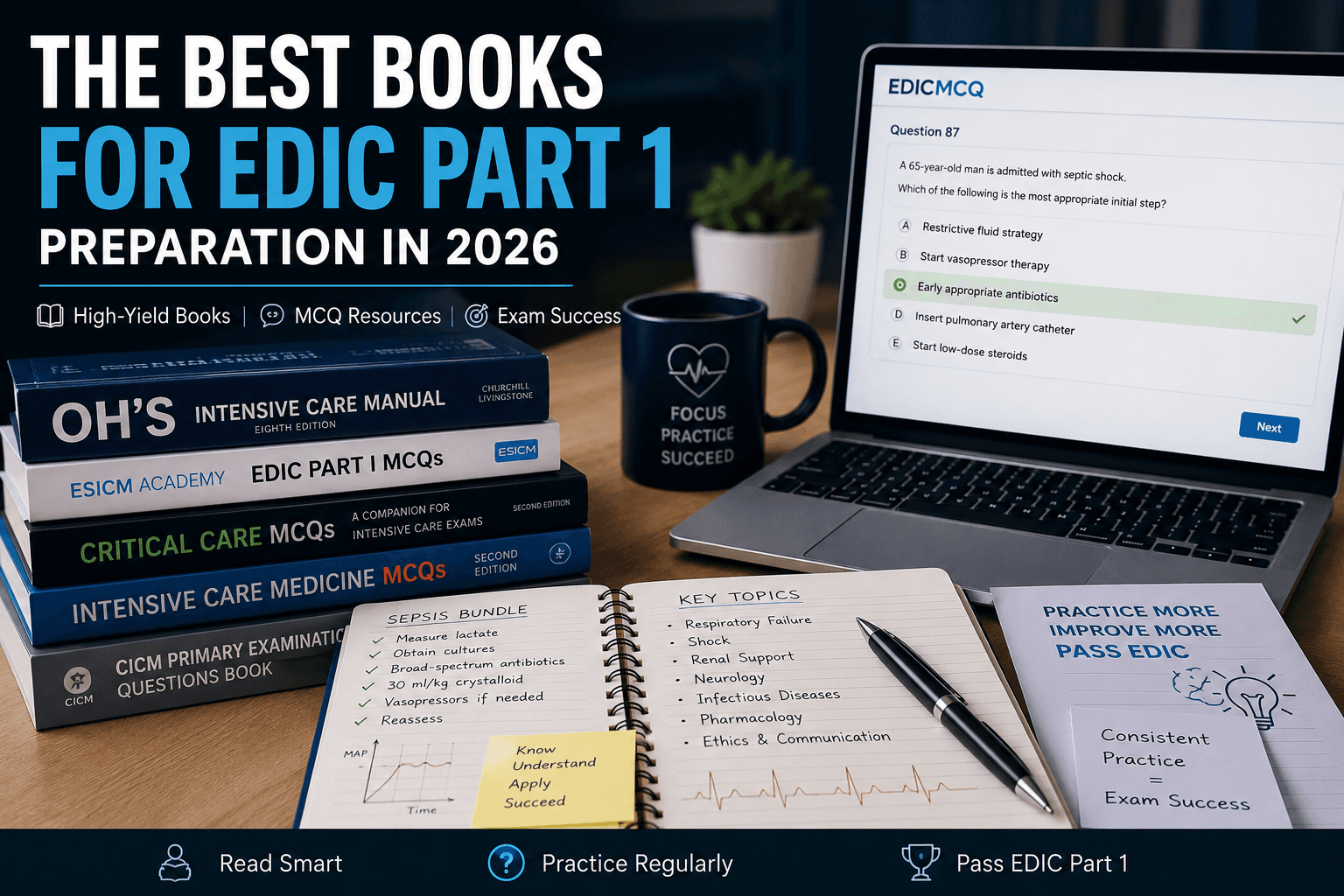
Most successful candidates rely on a combination of a major intensive care textbook, focused review material, and a large question bank.
Textbooks provide depth and understanding. Question banks provide exam technique and reveal knowledge gaps. The most effective preparation combines both approaches.
The advantage of high-quality question banks is that they expose candidates to the style of reasoning required in the examination. They also highlight recurring themes that appear repeatedly across the syllabus.
When reviewing questions, the explanation is often more important than whether you answered correctly. Every question should become a learning opportunity.
How Long Should You Study for EDIC?
This is perhaps the most common question asked by candidates.
The honest answer is that it depends on your background.
An intensivist working full-time in a busy tertiary ICU with recent examination experience may require significantly less preparation than someone returning to formal study after many years.
For most candidates, a structured preparation period of four to six months is reasonable.
The key is consistency.
Studying two hours every day for six months is generally more effective than attempting twelve-hour revision sessions during the final few weeks.
Many successful candidates aim to complete at least several thousand practice questions during their preparation period. This may sound excessive initially, but repeated exposure to questions is one of the most effective ways to consolidate knowledge.
The Importance of Question-Based Learning
One of the strongest predictors of success is the number of high-quality practice questions completed before the examination.
Questions force active engagement with the material.
They reveal weaknesses that textbooks often conceal.
They improve recall.
They improve examination technique.
Most importantly, they train candidates to think in the style required by the examiners.
Many candidates are surprised to discover that they can recognise information when reading a textbook but cannot retrieve it when faced with a question.
Question-based learning bridges this gap.
A useful strategy is to review explanations carefully, create notes from mistakes, and revisit difficult topics repeatedly.
The goal is not merely to answer questions correctly but to understand why the correct answer is correct and why the alternatives are incorrect.
Building an Effective Study Plan
A realistic study plan should fit around clinical work rather than compete with it.
Most ICU doctors preparing for EDIC are working full-time, often including nights, weekends, and on-call commitments.
Therefore, overly ambitious study schedules frequently fail.
Instead, focus on sustainability.
Many successful candidates dedicate weekdays to question practice and use weekends for deeper reading around weaker areas.
Regular revision is more important than marathon study sessions.
Small amounts of daily progress accumulate surprisingly quickly over several months.
Consistency usually beats intensity.
Common Mistakes During the Final Month
As the examination approaches, anxiety naturally increases.
Many candidates respond by attempting to learn entirely new subjects. This is rarely the best strategy.
The final month should focus primarily on consolidation.
Reviewing previously studied material generally provides a better return on investment than starting unfamiliar textbooks.
Another common mistake is neglecting rest.
Sleep deprivation significantly impairs memory, concentration, and examination performance.
The final week should prioritise confidence, consolidation, and maintaining physical wellbeing.
Candidates often underestimate how much performance depends upon arriving at the examination mentally fresh.
Exam-Day Strategy
Knowledge alone is not enough.
The EDIC examination is demanding, and effective examination technique can make a substantial difference.
Read questions carefully.
Pay attention to qualifying words such as "most likely", "best", "least", or "initial".
Avoid changing answers impulsively.
Research consistently suggests that first instincts are often correct unless there is a clear reason to revise an answer.
Manage time carefully.
Difficult questions should not consume disproportionate amounts of examination time.
Sometimes the best approach is to make the most informed choice available, flag the question mentally, and move on.
Remember that no candidate answers every question with complete certainty.
The examination is designed to challenge even highly experienced intensivists.
What Successful Candidates Have in Common
When speaking to candidates who pass EDIC, several recurring themes emerge.
They study consistently.
They complete large numbers of practice questions.
They actively identify weaknesses rather than avoiding them.
They revise physiology thoroughly.
They understand concepts rather than memorising isolated facts.
They accept that uncertainty is part of the process.
Perhaps most importantly, they recognise that preparation is a marathon rather than a sprint.
The candidates who succeed are not necessarily the smartest doctors in the room. They are often the ones who follow a structured plan for several months and trust the process.
Final Thoughts
Preparing for the European Diploma in Intensive Care can feel overwhelming at times. The syllabus is broad, the standards are high, and balancing revision with clinical work is challenging.
However, the examination is entirely achievable with a systematic approach.
Focus on understanding physiology. Use high-quality question banks extensively. Review your mistakes honestly. Study consistently rather than sporadically. Give yourself enough time.
Remember that the goal is not simply to pass an examination. The knowledge acquired during EDIC preparation often improves everyday intensive care practice, strengthens clinical reasoning, and deepens understanding of critically ill patients.
For many intensivists, the preparation process ultimately becomes as valuable as the qualification itself.
If you are currently preparing for EDIC Part 1, keep going. Every question answered, every topic revised, and every concept understood brings you one step closer to success.