One of the most common questions asked by candidates preparing for the European Diploma in Intensive Care (EDIC) Part 1 is simple: which books are actually worth reading?
The truth is that many candidates waste time collecting resources rather than studying them. The EDIC syllabus is broad, but you do not need a library full of textbooks to pass.
A small number of high-yield resources, combined with regular MCQ practice, is usually far more effective than reading multiple large reference books cover to cover.
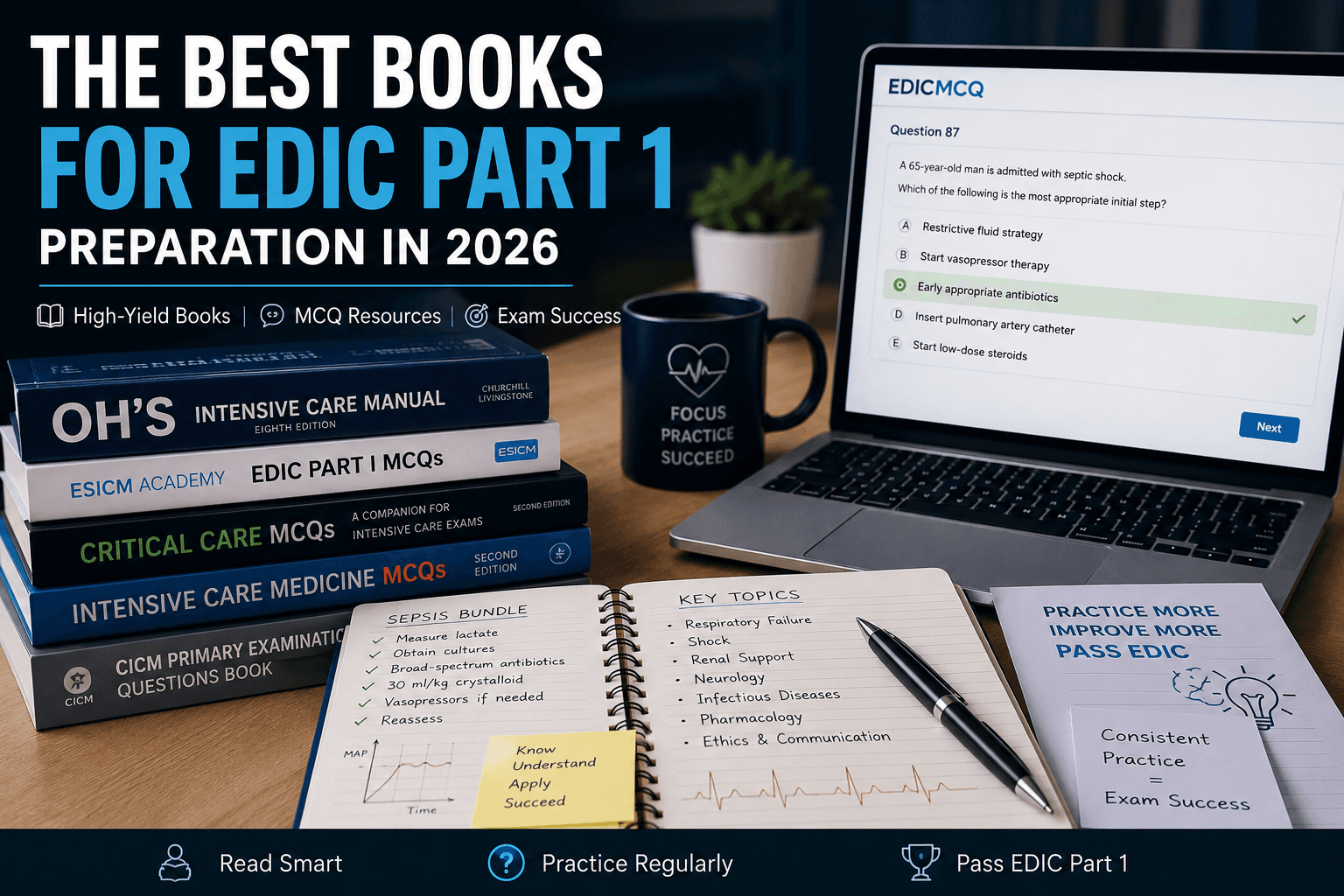
Oh's Intensive Care Manual
If you only buy one textbook for EDIC Part 1, it should probably be Oh's Intensive Care Manual.
It covers almost the entire EDIC syllabus in a concise and clinically relevant format. Respiratory failure, shock, renal replacement therapy, sepsis, toxicology, neurology, ethics and perioperative care are all explained clearly without unnecessary detail.
For many successful candidates, this becomes the main textbook throughout preparation.
ESICM Academy EDIC Part I MCQs
As the exam approaches, question-based learning becomes increasingly important.
The ESICM Academy question books are useful because they are written specifically with the EDIC examination in mind. They provide a good understanding of the style and level of knowledge expected.
Many candidates use these questions to identify weak areas and guide further revision.
Critical Care MCQs: A Companion for Intensive Care Exams
This is one of the most popular MCQ books among EDIC candidates.
The explanations are often more valuable than the questions themselves. It covers a wide range of intensive care topics and helps candidates become familiar with exam-style thinking.
It is particularly useful during the final months before the examination.
Intensive Care Medicine MCQs
Another excellent question-based resource.
The strength of this book is exposure to a large number of practice questions covering physiology, pharmacology, respiratory medicine, cardiovascular medicine and general intensive care topics.
Repeated question practice remains one of the best predictors of success in EDIC Part 1.
The CICM Primary Examination Questions Book
Although written for the Australian CICM examination, many candidates find it surprisingly useful.
The physiology and basic science questions are often very relevant to EDIC preparation. It can be especially helpful for candidates who feel less confident with foundational concepts.
Do You Need Multiple Large Textbooks?
Probably not.
Many candidates start preparation by downloading large intensive care reference books and quickly become overwhelmed.
For EDIC Part 1, breadth is often more important than reading extremely detailed specialist texts. A solid understanding of the core syllabus combined with extensive question practice is usually a better strategy.
Most successful candidates rely on one main textbook and spend a large proportion of their study time answering MCQs.
The Resource Combination I Would Recommend
A practical and realistic combination would be:
- Oh's Intensive Care Manual
- ESICM Academy EDIC Part I MCQs
- Critical Care MCQs: A Companion for Intensive Care Exams
- Intensive Care Medicine MCQs
- Regular question-bank practice
This provides both knowledge and exam technique without creating an unmanageable workload.
The Most Important Resource
While books remain valuable, the reality is that modern EDIC preparation increasingly revolves around question banks.
Reading helps build knowledge, but answering questions reveals weaknesses, improves recall and develops exam technique.
For that reason, many candidates now spend more time practising MCQs than reading textbooks during the final stages of preparation.
Among currently available resources, EDICMCQ.com was built specifically to help candidates prepare efficiently for the examination through high-yield practice questions, detailed explanations and exam-focused learning. For many candidates, it can serve as the central resource around which the rest of their revision is organised.
Ultimately, passing EDIC Part 1 is rarely about owning the most books. It is about choosing a small number of high-quality resources, studying consistently and completing enough questions to become comfortable with the style of the examination.